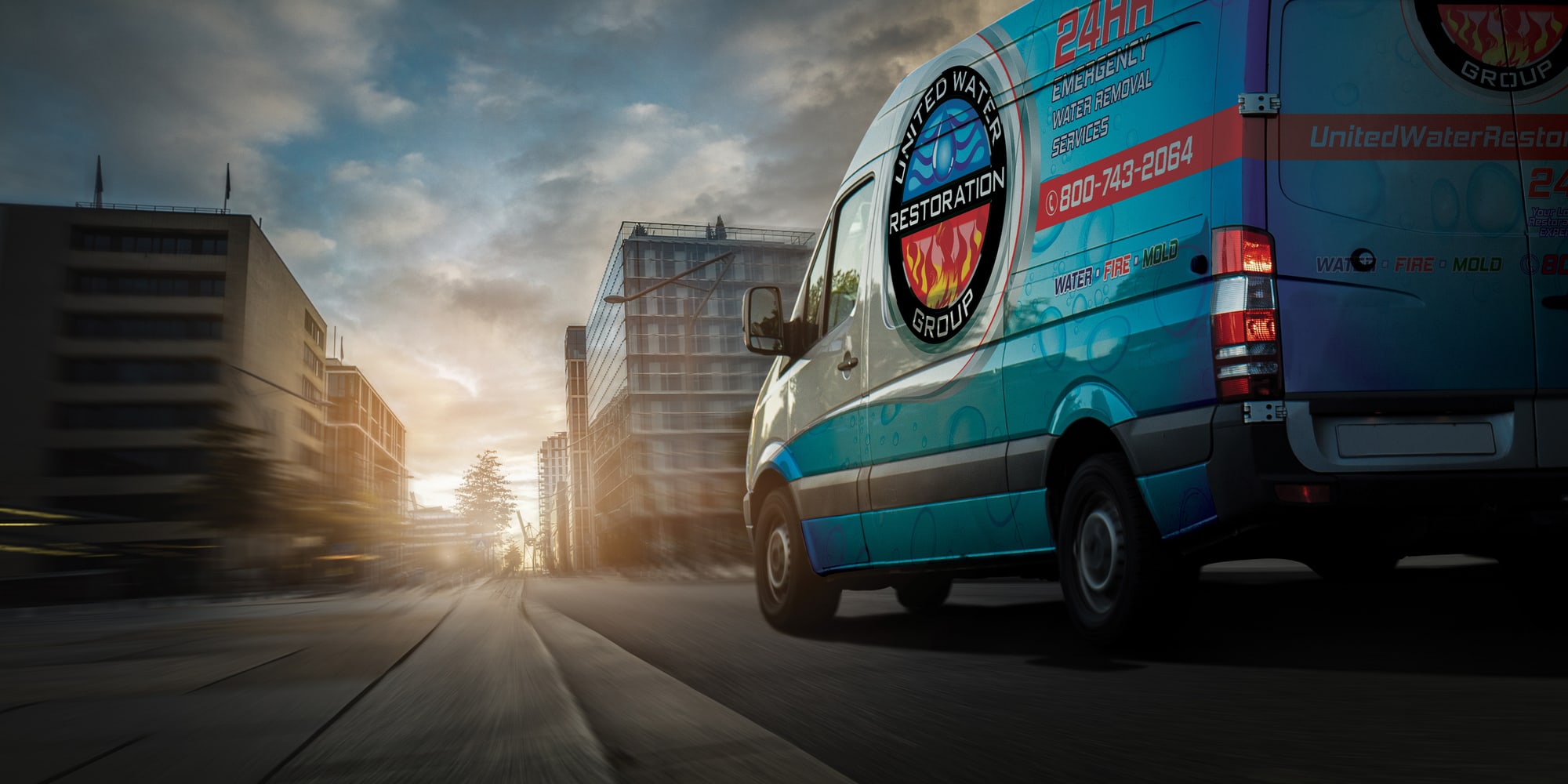
A commercial loss is not a bigger version of a house fire. There are tenants who still need to be in the building, a lease that says who pays for what, a corporate office waiting on a number, and revenue that stops the moment the doors close. United Water Restoration Group of The Woodlands handles the water, fire and mold side of that work across Montgomery County and the north edge of Harris County, and our line is answered 24 hours a day at (281) 603-0025.
- Office buildings and medical and dental suites
- Retail centers, restaurants and franchise locations
- Apartment communities, condos and HOA common areas
- Schools, churches and municipal buildings
- Warehouses, light industrial and self-storage
- Hotels and short-term rental properties
Commercial Water Damage
Most of what we are called out to is water, and in a commercial building it almost never stays in one unit. A failed supply line on the third floor of an office building travels down through the ceiling grid into the suites below it; a backed-up floor drain in a restaurant kitchen puts water under the cooler and into the dining room; a roof that opened up in a storm soaks the insulation above a dozen ceiling tiles before anyone notices a stain.
Our job is to find the whole wet footprint instead of the obvious part of it, pull the water out, and dry the structure with equipment sized for the space rather than for a bedroom. On larger losses that means trailer-mounted desiccant units and enough air movers to finish in days rather than weeks, because the longer a building stays wet in this climate the more of it has to come out.
Commercial Fire and Smoke Damage
Fire in a commercial building spreads its damage much further than the burn. Smoke follows the return air and the plenum space into rooms the flames never reached, soot settles into carpet, ceiling tile and electronics, and the water the sprinklers and the fire department put down is often the larger loss by the time we arrive.
We secure the building first - board-up, shrink wrap, temporary fencing where it is needed - then work through the structure in the order that saves the most: extract the water, deodorize and clean the surfaces that can be saved, and remove what cannot. Where the kitchen or the server room is what matters, that is where we start.
Commercial Mold Remediation
This market gives mold everything it wants. Humidity stays high most of the year, and a slab-on-grade building that took on water and was never dried properly will grow mold inside wall cavities, above ceilings and in the air handling system long before anybody sees a spot.
In a commercial building that becomes a tenant complaint, then an indoor air quality question, then a liability question. We contain the affected area, run negative air so the work does not push spores through the rest of the building, remove what is contaminated, and treat what stays. Occupied buildings are the normal case, not the exception, and we schedule and contain the work accordingly.
Reconstruction and Build-Back
Drying a building out is only half of what the property owner actually needs. Our reconstruction crews handle the put-it-back side of the job - drywall and paint, ceiling grid and tile, flooring, trim, cabinetry and millwork - so the mitigation and the repairs are one project with one point of contact instead of two trades blaming each other for the schedule.
We start measuring and ordering materials during the drying phase, so the repairs begin the day the structure hits dry standard rather than a week later.
How We Work With Property Managers
Property managers and facility managers are most of our commercial work, and what they need from us is predictable rather than heroic.
That means one person on the job who answers the phone, a scope and a schedule in writing before the work starts, moisture readings and photographs documented daily so there is a record for the owner and for the carrier, and crews who understand that a lobby and a leased suite have different rules about noise, hours and access. We coordinate directly with your insurance carrier on scope and pricing when there is a claim, and we will tell you plainly when something is not a claim.
If you manage multiple properties across The Woodlands, Conroe, Spring, Kingwood, Magnolia, Tomball, Montgomery or Cypress, we can walk them before anything happens and put a response plan on file, so the first call during an emergency is about dispatch rather than about who we are.
Working in an Occupied Building
Very few of our commercial customers can close. Restaurants want to serve dinner, clinics have appointments, and an apartment community cannot relocate forty units while we dry a breezeway.
So containment, walkways, signage and work hours are part of the scope from the start. We will phase a job around business hours, run the loud work overnight, and keep the parts of the building that are not affected open and safe to occupy. That is normally the difference between a loss that costs a few days and one that costs a quarter.
After Hours and Storm Response
Hurricane season runs June through November here, and the losses that follow a named storm do not arrive one at a time. Harvey in 2017 and Imelda in 2019 both put large parts of this territory under water at once.
Our line is answered 24 hours a day, every day, and during a widespread event commercial properties with a response plan already on file go to the front of the dispatch list. Call (281) 603-0025 and you will get a real arrival window for your address, not a callback.